
Why it matters for social justice and why it is important to understand the difference.
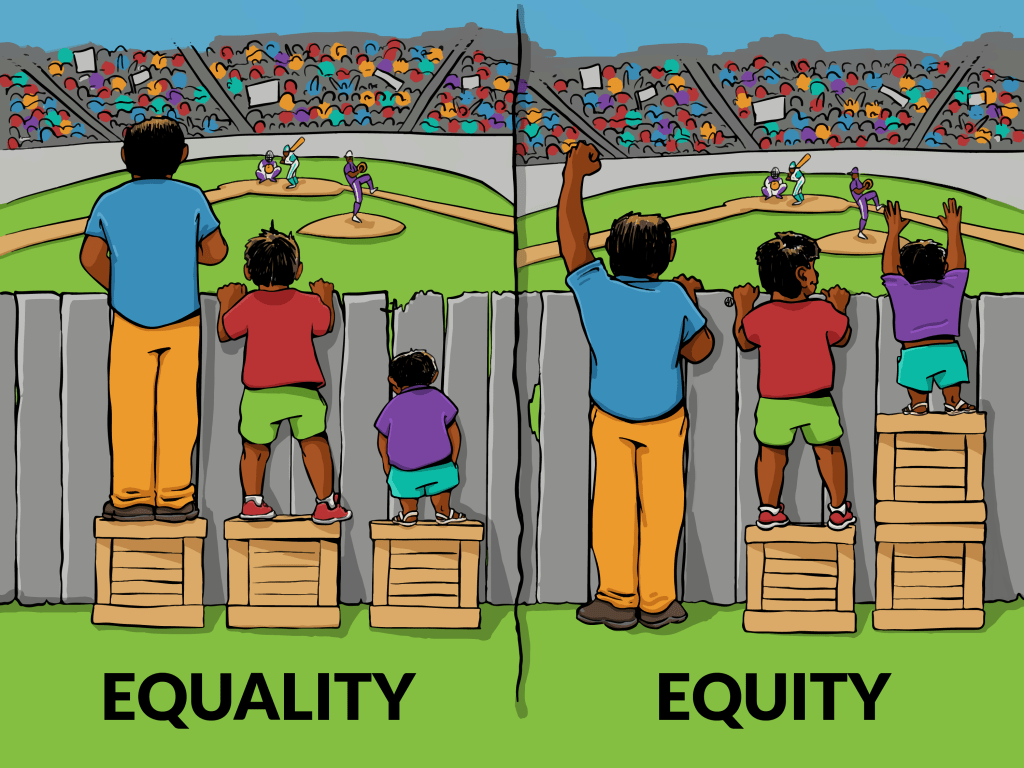
There is often confusion between the two terms equity and equality. Equality is about treating everyone the same and giving people equal opportunities. Equity is about giving people what they need to be successful.
As per the illustration showing three people watching a football game over the fence. We could treat all three people the same by giving them a box of the same height. What we are doing is attempting to find a solution to the problem or issue by focusing on the overall situation and being task or transactional focussed, as opposed to relational and people focused. This approach can involve seeing others as a means to an end rather than valuing them as individuals with their own unique experiences and perspectives. Please don’t think I’m suggesting that taking a task or transactional focus to achieve goals or find solutions to problems and issues is wrong. There are many situations and scenarios that will call for this approach which prioritizes the completion of tasks or objectives over building relationships and connecting with people. For example, in a warehouse where products need to be shipped out on time a task-oriented approach can help ensure that orders are processed and fulfilled efficiently, minimizing delays and errors. Similarly, in a hospital emergency room, a transactional approach may be necessary to quickly assess and treat patients in a time-sensitive manner. These situations can’t allow empathy and thinking of others’ emotions to get in the way of completing the task.
What I am suggesting though is that we often take a task orientated approach when we should be taking a relational approach to solve a problem and thinking of those affected as individuals rather than a group of people who will all fit into the same round hole. It’s a bit like those shape sorter toys and attempting to fit all the shapes, squares, hexagons, triangles all into the round hole. It will never happen, only the circles will be able to fit. To view a situation with equity means making sure there are the right shaped holes to accommodate all the shapes.
To treat people fairly, like the shape sorter toy, we need to treat individuals differently for them to be able to achieve the same goal or outcome. In the same illustration above, by giving the three people a box of different heights meant they were able to watch the game at the same height, achieving the same outcome for them all.
When my two daughters were growing up it was abundantly clear that they learnt and absorbed information quite differently. In New Zealand the education system splits schools into junior/middle school which is years 1-8 or ages 5-12 and high school which is years 9-13 or ages 12-18. When it came time for the girls to go to high school, we spent time with each of them visiting the different schools in the area and gathering information about the culture of the school, what the strengths were, the subjects offered and the style of teaching. It came as no surprise that they chose different schools. We wanted the best outcome for our children and therefore we were prepared to pay the fairly high cost that it meant to ourselves. Costs in terms of financial, it cost more to send children to different schools, costs in terms of time, there was so much more time involved in travel to after school activities, costs in terms of having to choose which child to support if their activities were on the same day. Regardless of this and looking back we are still pleased with the decisions we made as a family and wouldn’t change a thing.
Interestingly, when a relational approach is taken to solve a problem and equity is exercised it can surface many unconscious bias* that we weren’t aware of about ourselves. For example, a scholarship might be available to students from a lower socio-economic status. Students from a different socio-economic status may view this as unfair because they are not receiving the same opportunity in that situation. Our unconscious bias influences our thinking and the way we perceive the world without us realising. Most of will agree with the Universal Declaration of Human Rights (1948) that states every individual has a right to be treated fairly, but how we view the world and the lens we look through defines what we each believe is fair. Depending upon what country we were born, what socio-economic status we were born into, what religion or faith we follow, what gender we identify with, what abilities/disabilities we have, what life experiences in general we have will change the colour and transparency of the lens with which we view the world.
Back to the original question, why is equity important for social justice? For me it’s a simple answer of treating each individual person with love and respect. To do this we need to do two things: 1. Empathise by putting ourselves in another person’s shoes and ‘walking a mile’. When we understand the other person, we are in a better position to provide equitable solutions for treating people fairly.
But it’s not really a simple answer, is it? 😊 Share your thoughts below.
*Unconscious bias: Stay tuned 😊 I’ll unpack this and discuss this further in another post.
 Loving Change and All things Learning
Leave a comment